
Journal
Exploring the intersection of enterprise data, simulation, and decision-making. Insights from the Twinning Labs team.
A Signal of Where Enterprise AI Is Headed
Recently, Gartner highlighted the emergence of synthetic audiences, digital twins, and simulation systems as a new frontier in enterprise decision-making, featuring Twinning Labs among the companies helping shape this category. We view this as part of a much larger shift. For decades, enterprises have relied on dashboards, surveys, reports, and historical analytics to understand what happened. Yet the most important business decisions are not about the past; they are about the future. What happens if we launch this product? How will customers respond to this campaign? How will markets react to this pricing change? What are the second- and third-order effects of a strategic decision? Today's systems cannot answer these questions. They can only provide historical context. At Twinning Labs, we are building Enterprise World Models: persistent digital twins that continuously learn from behavioural, operational, and environmental signals to simulate how customers, markets, and systems respond before decisions are made. Not static personas. Not one-time research studies. Not prompt-engineered roleplaying. Living simulation systems grounded in reality. We believe the next generation of enterprise intelligence will not be defined by who has the most data, but by who can best model the world around them. The shift is profound: from analytics to simulation, from hindsight to foresight, and from observing reality to understanding possible futures. Just as every company today relies on databases to store information, every company tomorrow will rely on world models to navigate uncertainty. Before every consequential decision, there will be a simulation.

Posterior Twins: Modal Accuracy Is Not Distributional Fidelity
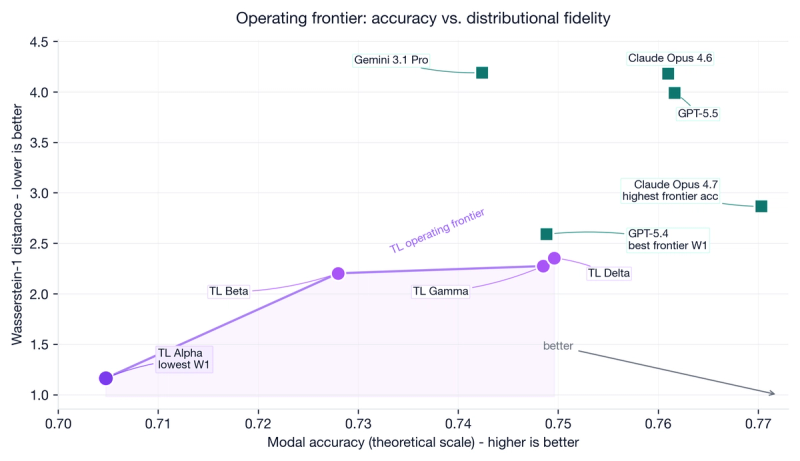
TL-Twin Alpha hits the lowest Wasserstein-1 in the public result set: W1 = 1.16. No frontier model gets close. Enterprise pricing, product, and marketing decisions live in the shape of a population, not the median answer. Which segments delay, downgrade, expand, defect? Whose enthusiasm comes at the cost of whose alienation? Modal accuracy cannot answer those. Distributional fidelity can. That is what we built Posterior Twins to deliver, and the numbers back it up. The 226-example evaluation, headline points: TL-Twin Alpha: lowest observed W1 of 1.16. Twinning Labs population-movement model. Frontier-leading. TL-Twin Delta: modal accuracy 0.750, W1 2.36. Direct scenario model. TL-Twin Gamma: modal accuracy 0.749, W1 2.28. Ensemble scenario model. Claude Opus 4.7: best frontier-model modal accuracy at 0.770, W1 = 2.87. GPT-5.4: best frontier-model W1 at 2.59 (still 2.2x Alpha). No single frontier model dominates every metric. The TL-Twin family does, by routing. Why W1 matters more than the leaderboard. Wasserstein-1 measures allocation error across the population curve. A model can call the leading offer correctly and still misplace demand, overstate enthusiasm, or miss the rejection tail. Budgets, pricing, sales capacity, and risk exposure live in that tail. Posterior Twins is not a persona prompt. It is an updated distribution over likely behavior under a decision context. Three parts: Memory Layer: governed enterprise evidence connected across customer, product, commercial, research, and outcome systems, preserved as durable twin context. Simulation Engine: turns memory state into repeatable scenario runs and measured distributions. TL-Twin model family: Alpha (population movement), Beta (calibrated behavior), Gamma (ensemble scenarios), Delta (direct scenarios). The system routes; teams do not pick models manually. A generic model call starts over each time. A Posterior Twin compounds: memory, scenarios, traces, and measured distributions become reusable decision infrastructure. That is the difference between a synthetic-response toy and a behavioral-simulation system mature enterprises can deploy in their own cloud. Read the full whitepaper for the methodology, the held-out protocol, and the per-segment results: twinninglabs.com/research/posterior-twins. If your decisions depend on the shape of a population, reach us at [email protected]. - Ankit Das, Founder & CTO, Twinning Labs
Twinning Labs featured in Kantar
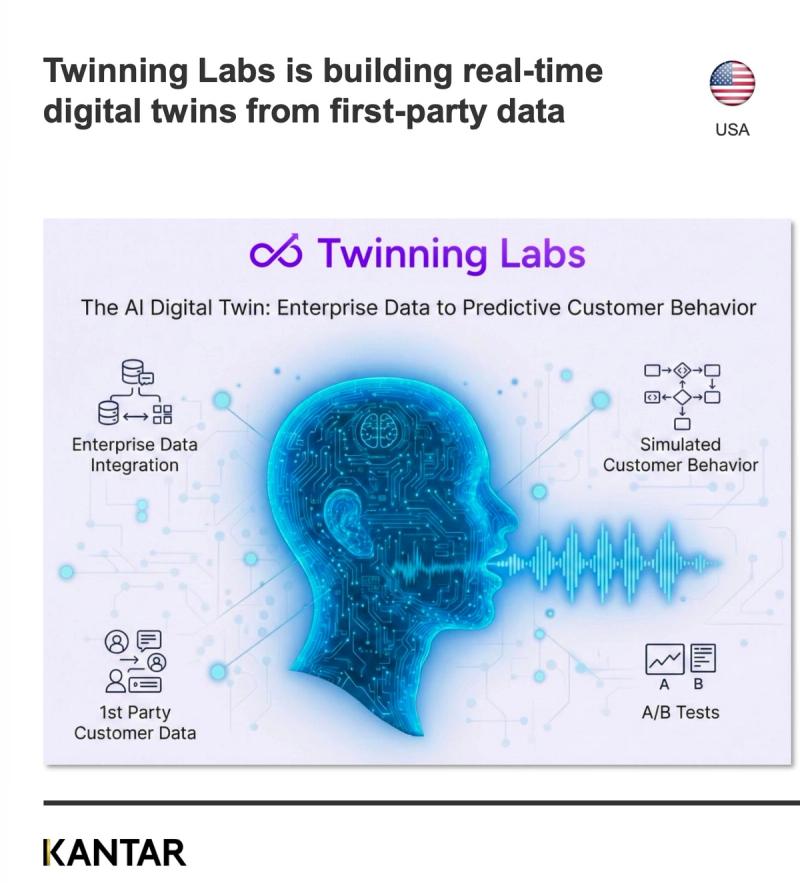
We're excited to share that Twinning Labs has been featured in Kantar's Global Innovation Tracker for the week of February 23, 2026: a weekly briefing that spotlights five commerce innovations from around the world chosen to inspire and educate industry leaders. Kantar's analysis highlights how Twinning Labs is transforming enterprise decision-making by building real-time digital twins from first-party data. Rather than relying on delayed reports and backward-looking forecasts, our platform lets teams simulate thousands of traceable, counterfactual scenarios (covering pricing, promotions, messaging, and product changes) and compress what traditionally takes weeks or months of analysis into hours. The feature also calls out what makes our approach fundamentally different: full traceability. Every simulation outcome is anchored in a persistent memory graph and tied back to source-of-truth inputs and assumptions, removing the "black-box" constraint that has historically limited adoption of advanced modeling. We're proud to be featured alongside innovations from Church & Dwight, Swiggy, TikTok Shop, and Iceland, companies rethinking how brands engage shoppers, scale commerce, and leverage AI across markets.
Twinning Labs Research
Technical whitepapers, methodology notes, and validation studies from the Twinning Labs team.